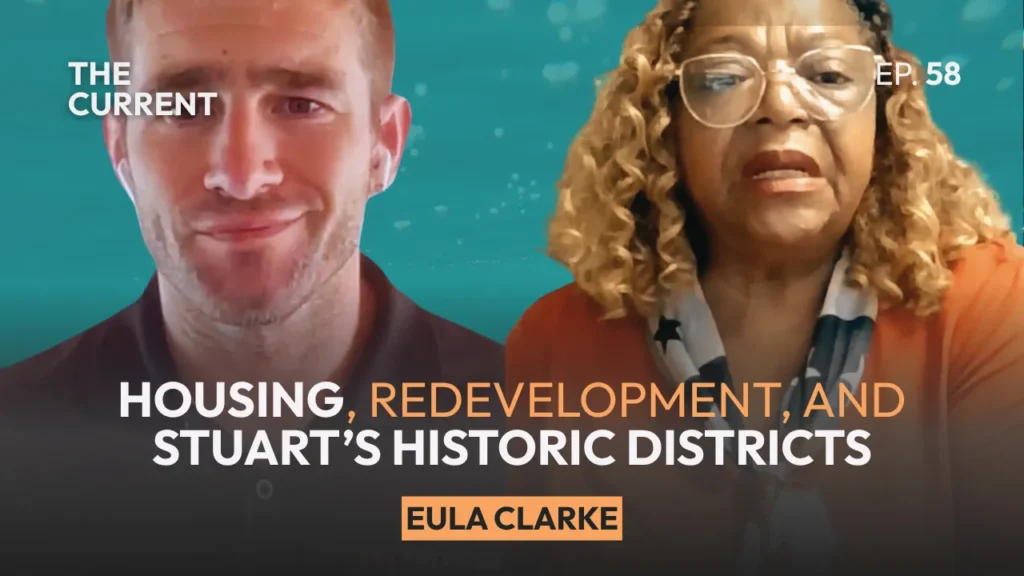
Eula Clarke has served on the Stuart City Commission since 2011, and she is running for reelection to Group 5 in the city’s upcoming election. A local attorney with a master’s degree in urban planning, Clarke joined The Current by TreasureCoast.com to discuss how Stuart manages growth as a nearly built-out city, the city’s role in housing affordability, and the recent National Historic Register designations for downtown Stuart and East Stuart.
Key topics Clarke discussed in the conversation:
- How growth in surrounding communities drives traffic through Stuart and Martin County
- The city’s approach to housing affordability through policy rather than construction
- Multifamily housing, accessory dwelling units, and infill redevelopment
- National Historic Register designations for downtown Stuart and East Stuart
- CRA-funded projects including Guy Davis Park and Martin Luther King Jr. Boulevard
- Her platform on responsible growth and protecting the St. Lucie River



Four Decades of Change in Stuart and Martin County
Clarke came to Martin County in 1985 to work for the Board of County Commissioners, arriving as the county was preparing long-range transportation plans tied to its designation as a metropolitan statistical area. She has lived in Stuart since 1988 and was involved in founding the local Arts Council, served on the local planning agency, and has been active with her church and the NAACP.
She said the region’s growth has been the throughline of her career in public service. She pointed to the growth of Port St. Lucie, which she said has expanded from a population under 50,000 when she arrived to several times that today, noting that many of those residents pass through Martin County for work, shopping, and medical care. She also cited development on Hutchinson Island as an example of growth that brings traffic through Stuart, the county seat.
Managing Growth in a Compact, Built-Out City
Clarke said Stuart’s small footprint shapes nearly every growth decision the commission makes. The city is largely built out, she said, so most of what comes before the commission today is redevelopment rather than new large-scale projects. She described the city’s approach as keeping development compact to match the water, sewer, and other services the city provides.
That compactness has meant more multifamily housing over the past two decades, which Clarke acknowledged has not been popular with everyone. She argued it has also created options for people who want to stay in the city, while many residents seeking single-family homes have moved to more affordable areas outside Stuart. She said the city is also working to maintain its stock of single-family homes, encourage infill redevelopment on small lots, and allow accessory dwelling units and duplexes as additional paths toward affordability.
The City’s Role in Housing Affordability
Clarke addressed what she described as a common misunderstanding about city government: that cities should provide affordable housing directly. She said the city does not build housing. Instead, she said, its role is creating predictable policies that let developers and homeowners build efficiently and, ideally, affordably.
She acknowledged the tension in that arrangement. Developers propose projects with affordable rents, she said, but prices sometimes rise well above those figures once the units are built, and it is difficult to structure deals that keep housing affordable while remaining profitable enough for builders to take on. She also noted that the last large development approved in the city, connected to the Costco project, drew controversy on both its commercial and residential sides, and its residential portion has not yet been built.
Listeners interested in other perspectives on growth and development in Stuart may want to hear TreasureCoast.com’s conversations with former Stuart mayor Chris Collins and Commissioner Sean Reid.
Historic Preservation and the National Historic Register
Clarke spoke at length about balancing growth with Stuart’s historic character, which she said “pays” in a literal sense. The charm of Downtown Stuart draws visitors and holds value for property owners, she argued, and the city’s preservation policies are designed to support owners maintaining older homes and buildings without making upkeep prohibitively expensive.
She highlighted the recent designation of both downtown Stuart and East Stuart on the National Register of Historic Places. Clarke said the designation opens access to tax credit incentives for renovations, technical assistance for hurricane-damaged properties, and eligibility for certain types of funding.
She gave particular attention to East Stuart, a historically African American community established in 1913, a year before Stuart itself incorporated. Clarke said the designation should help preserve and upgrade the neighborhood’s historic subdivisions in a way that is historically and culturally significant.
CRA Funds and Neighborhood Projects
Clarke explained that many of the visible improvements around downtown and East Stuart are funded by the city’s Community Redevelopment Agency. This tax increment financing district collects funds within its boundaries and reinvests them in the same area. She cited the Colorado Avenue road diet and streetscape, the roundabout at Martin Luther King Jr. Boulevard, utility undergrounding downtown, murals, and sidewalk projects as examples.
Current CRA-funded work includes the redevelopment of Guy Davis Park, which she said is underway, and a planned redesign of Martin Luther King Jr. Boulevard in East Stuart.
What Residents May Not See About City Government
Beyond housing, Clarke said residents are often frustrated with the pace of city responses on everything from policing and fire staffing to drainage after heavy rain. She said those expectations run up against budget realities, and noted that potential property tax changes at the state level could mean a meaningful revenue shortfall the city would need to absorb.
Her answer, she said, is listening: hearing from residents individually and through staff, not just at public meetings, so the city can develop plans before bringing them forward for public discussion. Things do not happen overnight in city government, she said, and residents get better results when there is ongoing communication in both directions.
Clarke’s Platform Heading Into the Election
Clarke closed with the priorities of her reelection campaign: responsible, sustainable growth, careful redevelopment that respects neighboring property owners, and protecting the St. Lucie River, which she called part of the city’s identity and charm. She noted the city has hired an environmental attorney to work on river issues. She also emphasized conservation more broadly, from recycling to water use, as part of keeping Stuart a place to live, work, and play.
Voters can learn more about Clarke at her campaign website, eulaclarkeforstuart.com.