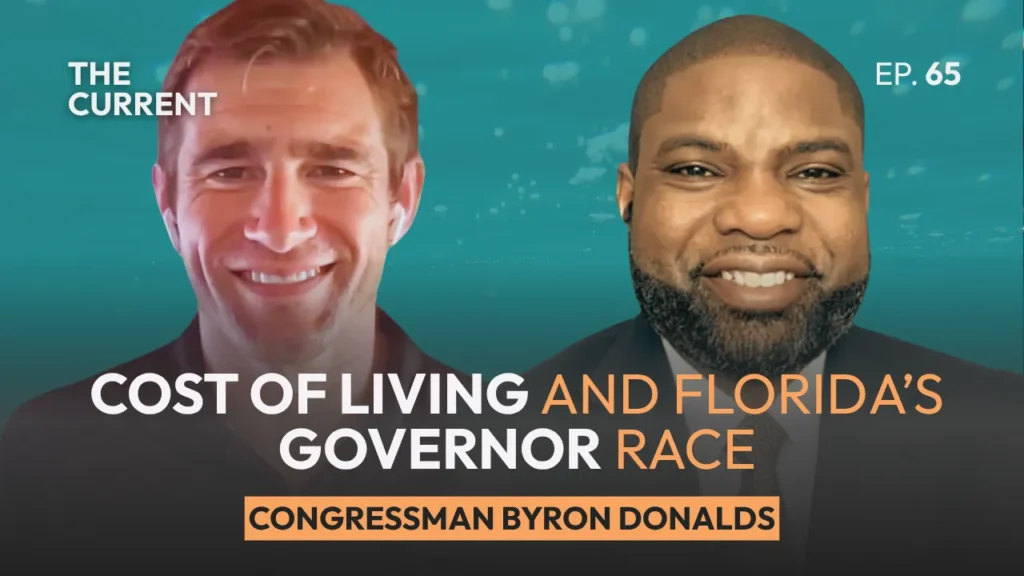
Congressman Byron Donalds, who represents Southwest Florida in the U.S. House, is running for governor in Florida’s election. He joined The Current by TreasureCoast.com to discuss the cost of living, insurance and property tax reform, health care price transparency, education, and how the state should manage the growth of the past several years.
Key positions Donalds discussed in the conversation:
- Support for Amendment 3 on property taxes
- Five specific insurance reforms, including catastrophe fund changes and an insurance scorecard
- Health care price transparency and reducing prior authorizations
- K-12 literacy and math mastery, plus expanded apprenticeship and trade pathways
- Regional growth planning and permitting reform to lower housing costs
- Buying development rights to keep agricultural land in production



Background and Why He’s Running
Donalds came to Florida at 17 from Brooklyn to attend college, spending three years at Florida A&M before transferring to and graduating from Florida State. He has lived in Naples for 23 years with his wife Erica and their three sons.
Before entering politics, he spent 17 years in banking, insurance, and financial services. He served in the Florida House, where he chaired a committee overseeing the state’s insurance market, and now serves in Congress.
Asked why he’s running, Donalds pointed to the need for a governor who understands how federal spending and policy pressures affect the state, and said his financial services background gives him specific knowledge of how to make regulatory adjustments that lower costs for families.
Cost of Living and Property Taxes
Donalds named cost of living as the top issue facing Florida. His framing on the campaign trail: when taxes and insurance exceed principal and interest on a mortgage, something has gone wrong, a problem he said seniors are experiencing directly.
He supports Amendment 3, the property tax measure on the November ballot, while emphasizing that sheriffs, firefighters, and emergency personnel need to retain adequate resources. He said property taxes have roughly doubled statewide over the past seven years, and argued local governments should have adopted rollback rates to keep bills stable as property values rose.
Five Insurance Reforms
Donalds laid out a specific set of insurance proposals, the most detailed portion of the conversation:
- Reform the catastrophe fund’s rapid cash buildup factor. The mechanism was added after Hurricane Wilma, and Donalds said the fund now holds enough that the factor can be removed, which he argued would directly lower premiums.
- Restructure home hardening programs. He said a meaningful share of current spending goes toward cosmetic upgrades rather than structural hardening, and wants those dollars refocused on genuine hardening for homes built before 1993 so owners qualify for lower rates.
- Maintain tort reform and keep Citizens enrollment low. Donalds noted Citizens Property Insurance is at its lowest level in decades and explained the assessment risk: if Citizens lacks funds to cover claims, it can assess other policyholders statewide. Keeping that population small, he argued, protects everyone.
- Attract more carriers to the market. More competition, he said, spreads risk and lowers costs.
- Create an insurance scorecard. Consumers would be able to see a carrier’s track record on claims and denials before purchasing, not just the premium price.
Health Care Price Transparency
On health care, Donalds’ central proposal is transparency. He wants hospitals and physician offices to post real cash prices for their top 20 services online, so patients know costs before walking in.
He drew an analogy to restaurant listings on mapping apps, where users see both ratings and price tier before deciding. He argued the same information should exist for health care, including consumer ratings, and that visible pricing would put competitive pressure on providers the same way it does in other industries.
He also wants to reduce prior authorization requirements, which he said increase rather than contain costs, and bring transparency to the payment system itself. His comparison: patients should know what they owe at the point of service rather than receiving a bill weeks later.
Education and Career Pathways
Donalds said education begins with mastery of math, reading, and writing. He emphasized phonemic awareness and reading instruction by third grade, explaining that decoding skills built early allow students to handle more complex material later. On math, he stressed grade-level mastery, so students don’t reach algebra or geometry missing foundational concepts like long division or order of operations.
He proposed extending personalized planning beyond its current use. Individualized Education Programs currently serve students with special needs or those who have fallen behind, and he said those resources should remain in place. But he wants students who are simply doing fine in school, without tutors or sports, to also have a plan identifying their strengths and mapping coursework toward potential careers.
On higher education, Donalds predicted universities will increasingly focus on degrees with clear economic return, saying he believes the era of a degree for its own sake is ending. He also emphasized apprenticeships, internships, on-the-job training, and the trades, noting that many business owners he has met on the campaign trail never finished college.
Managing Growth
Donalds acknowledged Florida’s substantial growth over recent years and said the state now has to manage its consequences. He noted some residents have grown tired of it, and said the answer is a strategy rather than trying to stop people from coming.
His approach centers on regional planning. Donalds described Florida as a state with many distinct regions: the Treasure Coast, Northeast Florida, the Panhandle, South Florida, Southwest Florida, the heartland counties around Lake Okeechobee, and the rural counties between I-10 and I-4, each with different needs. He wants county leaders within each region planning together on a ten, twenty, and thirty-year horizon for where workforce and affordable housing goes, what road systems look like, and how beaches and wildlife are protected.
On housing costs specifically, he cited a National Association of Home Builders study attributing a significant share of new home costs to government requirements rather than materials or labor, and called for permitting and planning reform at the local level.
On land conservation, Donalds said he has discussed with Agriculture Commissioner Wilton Simpson the approach of purchasing development rights from farmers to keep land in agricultural production rather than seeing it sold for development. He framed agriculture as a longstanding pillar of the state, noting Florida supplies a substantial share of the country’s produce during colder months. He also said the wildlife corridor matters, specifically mentioning panthers and black bears needing room to roam.
Listeners interested in how Treasure Coast leaders view growth pressure locally may want to hear TreasureCoast.com’s conversations on development and preservation across the region.
Building on Previous Administrations
Asked what he would do differently from previous governors, Donalds reframed the question. He described a progression of Florida governors each building on the last, and said his job would be building on what has worked while addressing challenges specific to this moment, primarily affordability, property taxes, and retooling the education system for future workforce needs.
He also offered a framework for how voters should evaluate candidates: since issues change over the course of a term, what matters most is a candidate’s decision-making process rather than their current positions alone.
Priorities and Vision
Donalds said the core of his campaign is what he calls the Florida dream, the way of life that has drawn people to the state. He recounted a conversation with a World War II veteran in The Villages who told him residents didn’t just buy a house; they bought into a way of life.
His priorities are affordability, preparing young Floridians to build sustainable lives in the state, and continued economic growth. On the economy, he highlighted commercial space as a particular opportunity, arguing Florida’s geography positions it to lead the Western Hemisphere in the industry. He emphasized that the jobs created extend well beyond engineers and scientists to electricians, contractors, and HVAC specialists.
Asked what he hopes Florida looks like a decade from now, his answer was simple: that it continues to be the best state in America.
Donalds pointed voters to his campaign website ahead of the November 3 election. For more conversations with candidates in Florida’s 2026 races, visit The Current by TreasureCoast.com.