At a Glance
Waldo Emmerson Sexton (1885-1967) transformed Vero Beach from a small Florida settlement into a tourist destination. He built a diverse empire spanning citrus farming, cattle ranching, and landmark attractions. The Florida Department of State named him a Great Floridian. Today, his creations like McKee Jungle Gardens, the Driftwood Inn, and Ocean Grill remain central to Vero Beach’s identity.
Arrival in Vero Beach & Early Ventures
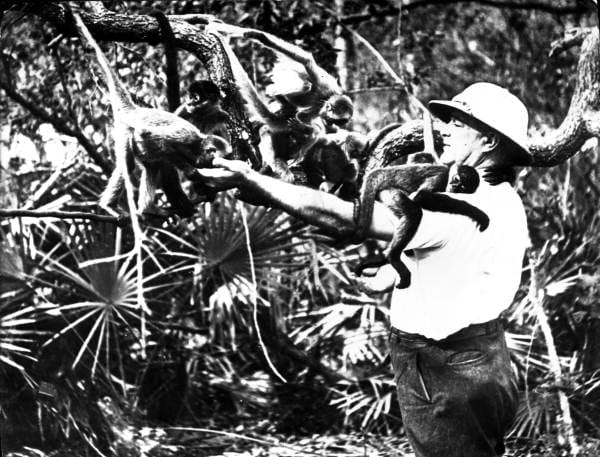
Waldo Sexton, playing with monkeys at McKee Jungle Gardens.
Discovery of Indian River County
Waldo Sexton arrived in what would become Vero Beach in 1914. At the time, he worked as a deep tillage machine salesman. He came to perform a demonstration on a local farm. However, a late-arriving expense check from his company forced him to stay several extra days at the Sleepy Eye Lodge.
This delay proved fortunate. The additional time allowed Sexton to explore the area. He quickly recognized its agricultural potential. Consequently, he decided to purchase a 40-acre tract of land. He then bought two neighboring 40-acre tracts during the following days. With $500 remaining and advice from Dr. Leroy Hutchinson, Sexton limited his initial investment to 120 acres.
Land Development and Real Estate
In 1914, Sexton joined the Indian River Farms Company as a sales agent. The company was excavating the drainage system that transformed wetlands into prime agricultural land. Sexton managed the company’s Cleveland, Ohio office. He also organized numerous prospect trips via rail car from Cincinnati to the developing Florida region.
During this period, attorney Charles H. McKee stopped in the area. He was traveling to his Palm Beach honeymoon. McKee stayed at the Sleepy Eye Lodge where he met Sexton. Before departing, he purchased 1,000 acres of land. When Charles died the following year, his cousin Cleveland engineer Arthur G. McKee bought out his holdings. This established a business partnership with Sexton that would span decades.
Sexton established Vero Beach Realty Company in 1914. This marked his entry into real estate development. By 1923, he had organized the Vero Beach Real Estate Board. He served as its president for multiple years. Additionally, he partnered in McKee Sexton Land Company and the Royal Park Company. Sexton personally selected the vistas for the first nine holes of the Royal Park Golf Course.
View this post on Instagram
Building an Agricultural Empire
Citrus Industry Leadership
By 1917, people considered Sexton an independent citrus grower. He had planted 10,000 orange trees. His citrus-related activities expanded rapidly to include multiple facets of the industry.
Sexton operated Indian River Products Company. This grove maintenance service provided professional care for citrus groves throughout the region. He owned several citrus groves outright. Furthermore, he served as president of the Oslo Citrus Growers Association, a cooperative packing house. He helped organize the Indian River Citrus League. He also became one of the first exhibitors of Indian River Citrus at the Tampa State Fair.
Sexton’s agricultural innovation extended beyond standard citrus varieties. He developed three varieties of avocados. The U.S. Department of Agriculture officially named one “Sexton” in recognition of his horticultural contributions.
In 1920, Sexton and his first cousin Walter Buckingham incorporated the Oslo Packing Company. Sexton served as president while Buckingham served as secretary and treasurer. The company processed and packaged citrus from the growing number of groves in Indian River County.
Dairy and Cattle Operations
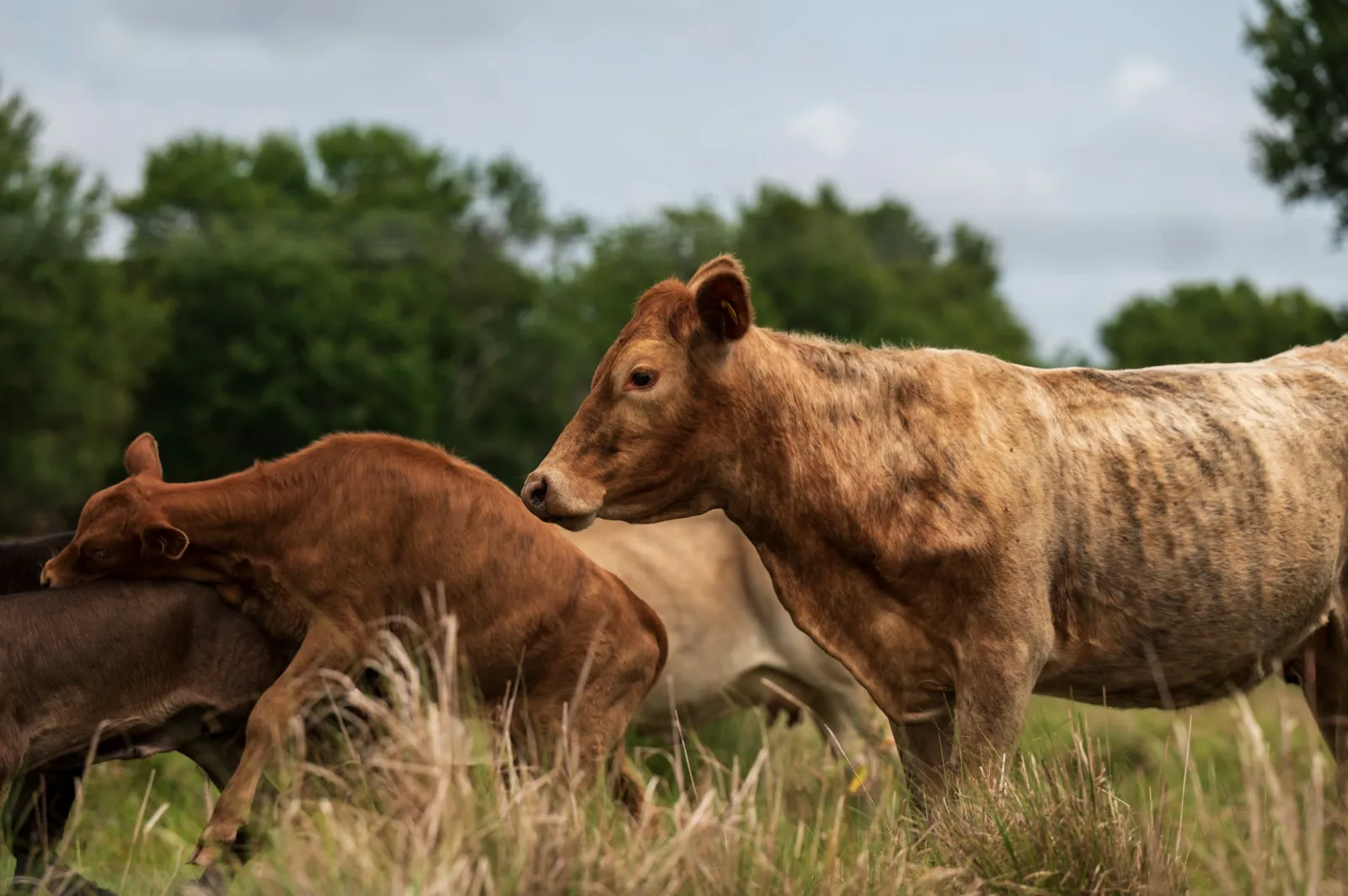
In 1924, Sexton established the Vero Beach Dairy, the first dairy operation in Indian River County. He pioneered experimental crossbreeding by crossing Guinea bulls with Brahman cows, attempting to produce an animal requiring minimal feed that could withstand Florida’s intense heat and insects.
During the Great Depression, Sexton served as a member of the Florida Production Credit Association. This organization provided short-term loans to farmers, enabling them to plant crops during economically challenging times.
Treasure Hammock Ranch
In 1943, Sexton established Treasure Hammock Ranch. He purchased approximately 640 acres of undeveloped land at $10 per acre. In a letter to the Federal Land Bank requesting financing, Sexton described the property as “one of the finest tracts of undeveloped land in the county.” He explained that the additional pasture was needed to expand his dairy operation. The expanded operation would meet increased demand for milk at Vero’s Naval Air Base during World War II.
Sexton intended to pass the ranch to his sons Ralph and Randy. At the time, they were ages 15 and 13. The ranch remained operational under Sexton family descendants for generations. The farmstead features a bridge, barn, cattle pens, weigh scales, dipping vat, and unique wooden squeeze chute. Workers built these structures with vernacular materials. In 2013, officials listed the farmstead on the National Register of Historic Places.
In 2007, Sexton’s descendants enacted a historic conservation measure. They established the first agricultural conservation easement in Indian River County. This fell under the Rural and Family Lands Protection program. The easement ensures that developers can never convert the land into residential housing. This proved historically significant. Florida’s population grew from 1 million people in 1900 to over 22 million today. Meanwhile, the cattle population remained steady at approximately 1 million.
McKee Jungle Gardens: A Tourist Attraction is Born
From Preservation to Paradise
Sexton’s first major venture into tourism was McKee Jungle Gardens. In 1918, he and business partner Arthur G. McKee purchased 80 acres. Initially, they acquired the land with plans to plant citrus groves along the Indian River Lagoon. However, Sexton and McKee decided the landscape was too beautiful to plow under. Instead, they chose to preserve the natural hammock.
The property served multiple purposes. Sexton and McKee used the land to save the area from development. They also explored their collection of rare flora and fauna. Additionally, they tested the commercial viability of various plants including ramie and rubber trees.
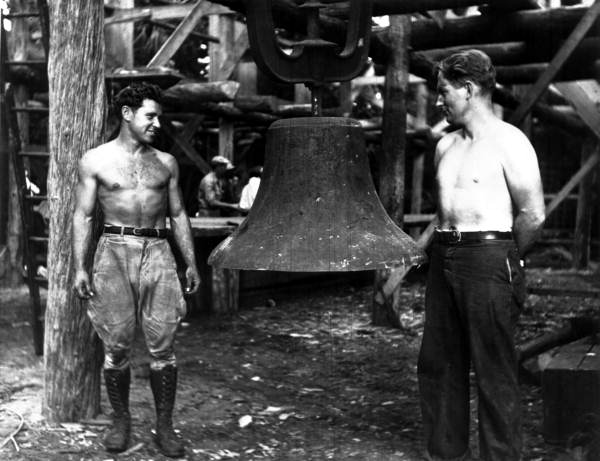
Two employees looking at a bell at McKee Jungle Gardens. Waldo Sexton had an affinity for bells and ironwork.
Garden Development and Design
McKee Jungle Gardens officially opened to the public in 1931. Landscape architect William Lyman Phillips designed the waterways and landscapes. His work included the famous Cathedral of Palms. This featured 300 royal palms set on a grid pattern.
David Fairchild, a renowned botanist and friend of Sexton, supplied many exotic plants for the project. The gardens featured thousands of orchids and lilies alongside native Florida oaks and palms. In 1932, a reviewer who had toured tropical botanical gardens worldwide visited McKee Jungle Gardens.
This included Peradeniya in Ceylon. He approached his visit “with that secret doubt we conceal before our friends’ local enthusiasm.” However, he wrote that “This doubt was quickly resolved.” The reviewer praised the collection of rare tropical plants framed by native growth. He noted it set “an example for conservation and intelligent use of indigenous growth.”
Sexton’s Architectural Vision
Sexton operated without an architect or formal plans. Nevertheless, he built and decorated the Hall of Giants and the Spanish Kitchen. He used cypress milled in Florida, salvaged materials, and items from his extensive bell collection. For the Hall of Giants, he located a massive mahogany board. It measured 35 feet long. He had seen it at the Louisiana Purchase Exposition in 1904. Subsequently, he turned it into a table. The large iron gates came from the demolished Whitehall Hotel in Palm Beach.
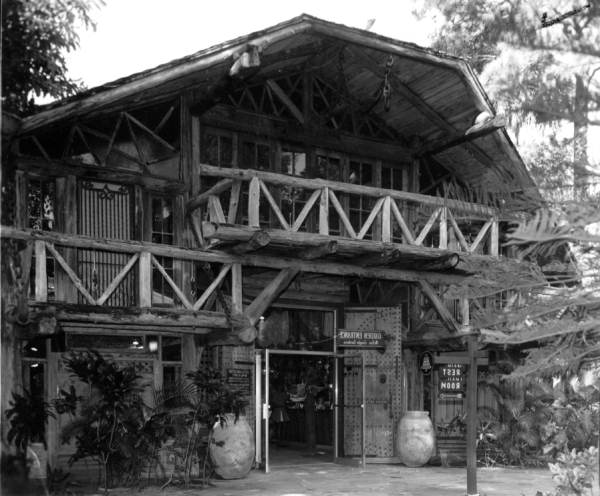
The Hall at McKee Jungle Gardens, circa 1970. Built of pine and cypress boards; used as a dining room and gift shop.
The gardens also featured monkeys, alligators, and bathing beauties. Contemporary accounts called them “the wacky buildings and collections of Waldo E. Sexton, the folk architect and Florida nurseryman.”
McKee Jungle Gardens attracted crowds of 100,000 visitors annually in its prime. The attraction operated from 1931 to 1976. Eventually, it closed as Florida tourism patterns shifted. In 2001, 18 of the original acres reopened as McKee Botanical Gardens. Officials added the site to the National Register of Historic Places on January 7, 1998.
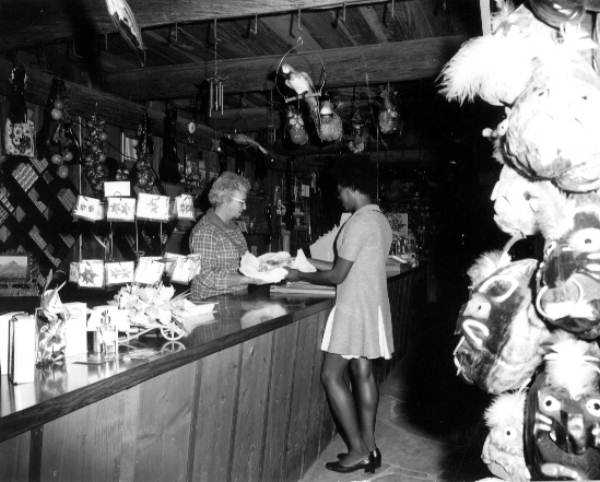
Interior of the McKee Jungle Gardens gift shop, circa 1970.
The Driftwood Inn: A Vero Beach Icon
From Beach House to Resort
Construction on what would become the Driftwood Inn began in 1935. The Sextons built it as a private beach house. They called it the “Breezeway” due to the opening in the central portion of the first floor. Workers completed the structure in 1937. The original structure featured two rooms flanking the first floor. A kitchen occupied the second floor above the breezeway.
The original beach house expanded in 1937. Workers added a north wing. They added the south wing in 1939. The original portion became the central section. The building featured board and batten exterior walls. It also had wood-shingled gable ends with decorative truss work and rustic balcony railings.
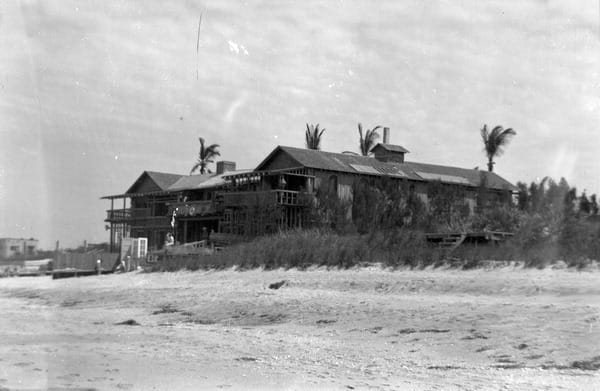
The Driftwood Inn, circa 1950; it was added to the National Register of Historic Places in 1994.
Two stone walls marked the courtyard. Workers embedded two rusty ancient cannons into these walls. Ceramic tiles decorated the courtyard floor. A breezeway at the east end featured walls with graffiti from visitors. It also displayed applied ornaments and portions of a wood mantel.
The Sextons originally built it as a family home. However, Elsebeth Sexton soon began operating it as a small resort hotel. No restaurant existed nearby. Therefore, she began cooking breakfast for guests in the family kitchen. This success led to the founding of Waldo’s Restaurant in 1947. Workers constructed it adjacent to the original Breezeway building.
Architectural Style and Salvaged Treasures
The Driftwood buildings maintained unusual workmanship, materials, and original design features. These represented unique vernacular architecture. The design allowed Sexton to express his vision. As a world traveler and passionate collector, Sexton amassed antiques, cannons, mosaics, paintings, bells, furniture, and relief sculpture.
He incorporated hundreds of artifacts from various trips into the buildings and grounds. Part of the timber used to build the Driftwood came from a salvaged barn. A hurricane had blown down the barn. Sexton was especially fond of bells. He amassed a collection of 250 bells of various types and sizes. These came from churches, trains, ships, and schools. The bells decorated building exteriors. Staff used them to welcome guests on arrival and ring out farewells on departure.
Continued Expansion
Sexton continued expanding the Driftwood complex after erecting the inn and restaurant. Workers built a small office in 1949. That same year, he moved in a row of fishing shacks. These served as guest rooms and later as small shops. In 1986, workers converted them back to guest rooms. In 1963, a 15-unit apartment building was added west of the original Breezeway building. Sexton’s son Ralph erected a four-story building to the south in 1965. This provided more apartment units. The owners converted the complex to interval ownership in 1979.
Officials added the Driftwood Inn to the National Register of Historic Places on August 6, 1994. By 1991, the Driftwood Resort was generating over $2 million annually for the local economy.
Ocean Grill & Vero Beach Landmarks
Waterfront Dining Destination
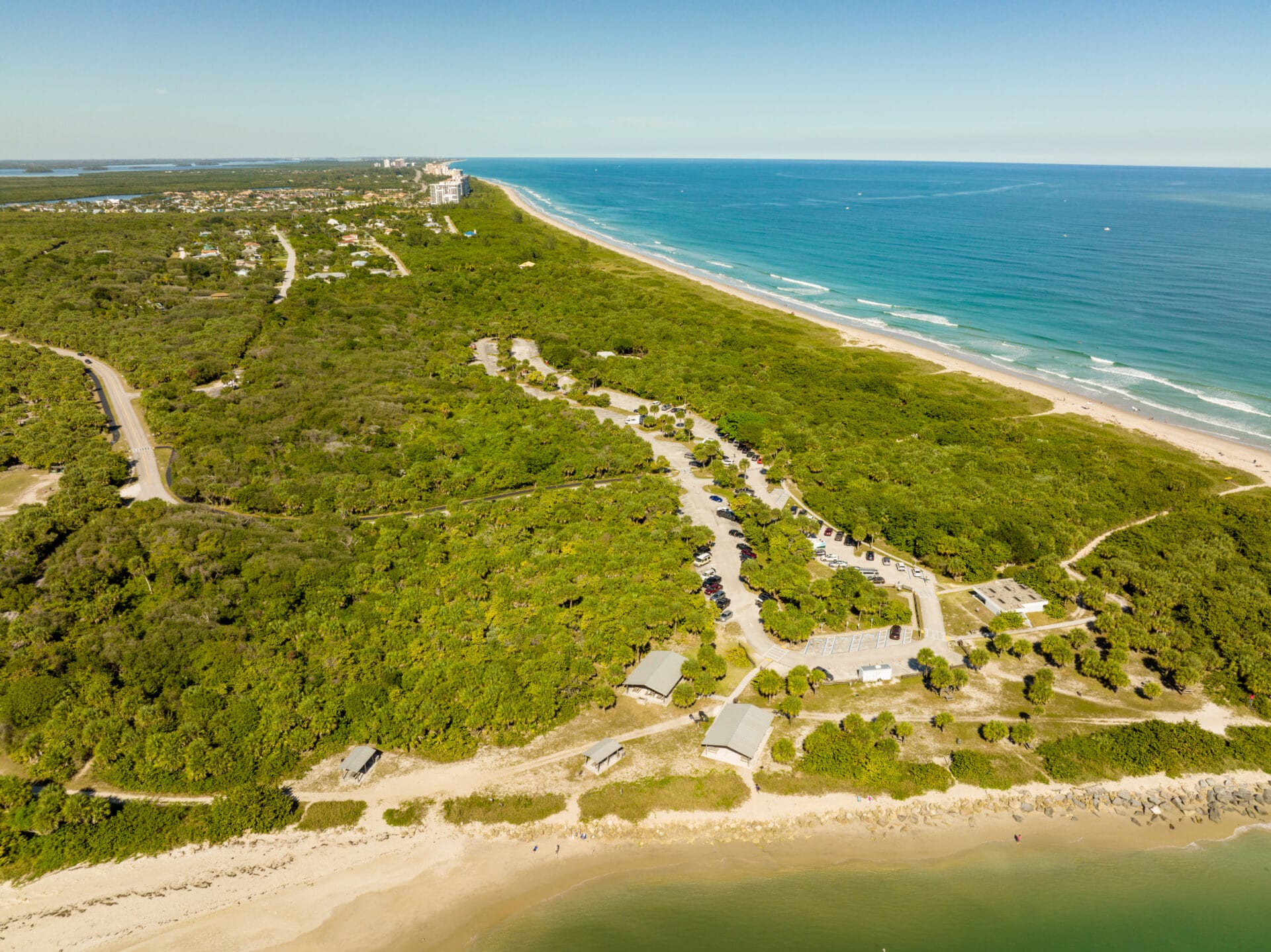
In 1941, Sexton built the Ocean Grill at 1050 Sexton Plaza. The restaurant featured similar use of salvaged materials and collected artifacts as his other properties. This created a distinctive dining experience along the waterfront. The Ocean Grill became one of Vero Beach’s most recognized restaurants. It remains operational today.
The Patio Restaurant
Sexton built the Patio Restaurant on 21st Street close to Downtown Vero Beach in the 1930s. He leased it as one of the original Howard Johnson’s ice cream parlors. Later, it served as a gift shop and fruit stand. It also housed Waldo’s real estate office. The building showcased Sexton’s eclectic architectural style and collection of unique objects.
Other Establishments
In the late 1950s, Sexton built the Turf Club on 43rd Avenue. He also created Waldo’s Mountain and the Szechuan Palace. However, workers have since demolished these structures. Each establishment featured Sexton’s trademark use of salvaged materials, collected artifacts, and unexpected architectural elements.
Salvaged Treasures from Palm Beach
Sexton developed relationships with Palm Beach estates. He acquired pieces from Addison Mizner-designed Spanish-style mansions. These came as workers demolished or renovated them. Mizner was the renowned architect who defined Palm Beach’s Mediterranean Revival architectural style in the 1920s.
According to Palm Beach historian Augustus Mayhew, Sexton would visit Palm Beach estates. He selected Mizner-designed and manufactured objects to save and repurpose for his Vero Beach landmarks. A 2007 Palm Beach News article stated that “Mizner would no doubt immediately acknowledge the life’s work of his kindred spirit and friend, Waldo Sexton.” The article called him “the man who saved what might have been lost forever.” It noted he “shared his respect for the past and prescience of history’s enduring commercial value.”
Recognizable pieces from Mizner mansions continue to attract visitors to Sexton’s Vero Beach establishments. This creates a unique connection between Palm Beach’s gilded age and Vero Beach’s developing tourist economy.
The Sexton Homestead & Secret Garden
A Family Compound
Sexton built his first home on property at 5000 12th Street in 1917. Over the years, he expanded the house to two stories. This accommodated his family of four children. When daughter Barbara Tripson became pregnant with her first child, Sexton built a second home next door. He built it for her and her husband John Tripson.
This structure became known as “The Treehouse.” It featured Sexton’s trademark attention to detail. This included extensive carpentry, wrought-iron furniture, elephant and Buddha collections, detailed brickwork, and a ceiling-tall fireplace. The property featured tropical landscaping. It also had a secret garden with bamboo surroundings and an outdoor kitchen. This reflected Sexton’s belief that everywhere one looks should reveal something fun and interesting.
Today, you will find Waldo’s Secret Garden at this site.
View this post on Instagram
Agricultural Heritage
The homestead property housed Vero Beach Dairy. John Tripson later took over operations and renamed it Tripson Dairy. The property remains with Sexton descendants. Today, it is part of the Griffin family’s cattle ranch operation.
Visitors can tour Waldo’s Secret Garden by appointment. This allows them to experience Sexton’s original homestead. They can see the eclectic collections, unique architecture, and tropical gardens that characterize his work throughout Vero Beach.
Character & Vision
The Philosophy Behind the Buildings
Sexton embraced an unconventional approach to architecture and design. He operated without architects or formal plans for most projects. Nevertheless, he built structures using salvaged materials, collected artifacts, and creative improvisation. His buildings featured driftwood, wrought iron, ceramic tiles, bells, and unexpected objects. These created visual interest at every turn.
Local historian Ruth Stanbridge and other researchers have documented Sexton’s philosophy. He believed in collecting objects that were fun and interesting, worth staring at. His homes and commercial structures reflected this philosophy. They featured eclectic collections ranging from Buddhas and elephants to cannons and salvaged architectural elements.
\
Reputation & Personality
One journalist described Sexton memorably. He wrote that Sexton was “a man who was not afraid to render an opinion and who never hesitated to embroider a story.” The journalist noted he “loved martinis and women, bells and things from the sea.” He added that Sexton “possessed a compelling urge to create.” The article mentioned that “Some people called him an irresponsible screwball.” However, this was “an untruth he shrewdly did not deny, knowing that the world loves an eccentric.”
Sexton himself coined the phrase “I’d rather be a liar than a bore.” He embraced his reputation for colorful storytelling and elaborate tales. People described him variously as “one of the most colorful persons that Florida has ever known.” Others called him an “imaginative entrepreneur,” an “outrageous, old-time eccentric,” and an “irresponsible screw-ball.”
Community Leadership & Impact
Civic Contributions
Beyond his business enterprises, Sexton served as a civic leader. He was instrumental in furthering the citrus, cattle, and tourism industries in Indian River County. He served as president of the Vero National Farm Loan Association. This local group processed loans for the Langwick Land Company Corporation, owners of a Vero Beach subdivision.
Transforming Vero Beach Tourism
The Driftwood Inn and restaurant served as keystones. They transformed the small oceanside community of Vero Beach into a tourist destination. Sexton combined natural beauty, unique architecture, and memorable dining experiences. This created attractions that drew visitors from across the country.
His emphasis on preserving natural landscapes while developing tourism attractions established a template. Vero Beach continues to follow this model today. The decision to save McKee Jungle Gardens from citrus development demonstrated early environmental awareness. This preceded modern conservation movements by decades.

Sexton Plaza Beach
Recognition & Honors
Lifetime Recognition
In 1958, Vero Beach honored Sexton as “one of Indian River County’s outstanding citizens.” The city celebrated “Waldo Sexton Day.” Events included a parade in his honor, an organ concert, a band concert, and a street dance. Additionally, 5,000 people attended a free barbecue dinner. The city also dedicated Sexton Plaza that day.
Posthumous Honors
The Indian River Chapter of American Institute of Architects presented Sexton posthumously with an important award. In 1992-1993, they gave him the Ambiance Award. This honored Waldo’s Breezeway, Ocean Grill Restaurant, Patio Restaurant, and Turf Club. The award recognized these structures as making Vero Beach what it is today.
The Florida Department of State named Sexton to the list of Great Floridians. This recognition honored his agricultural contributions to the state.
Sexton Plaza in Vero Beach bears his name. It serves as a permanent reminder of his contributions to the community.
Educational Legacy
Indian River Charter High School staff performed a play about Sexton in November 2017, January 2018, and January 2019. The play explored Sexton’s contact with African American poet and author Zora Neale Hurston. This honored both figures’ contributions to Florida culture. It also celebrated the diverse personalities that shaped the Treasure Coast.
Lasting Impact on the Treasure Coast
Waldo Emmerson Sexton died December 28, 1967, at age 82. However, his enterprises, architectural creations, and agricultural innovations continue to shape the Treasure Coast region today.
McKee Botanical Garden, the Driftwood Inn, Ocean Grill, and other Sexton landmarks remain central to Vero Beach tourism and local identity. Officials have listed multiple structures on the National Register of Historic Places. This ensures preservation of Sexton’s unique architectural vision for future generations.
Treasure Hammock Ranch continues operating under Sexton family descendants. It represents one of the few remaining large-scale cattle ranches in Indian River County. The agricultural conservation easement enacted in 2007 ensures this land will never face development pressure. Consequently, it preserves a piece of Florida’s agricultural past in perpetuity.
A Distinctive Vero Beach Character
Sexton’s belief shaped Vero Beach’s identity. He maintained that everywhere one looks should reveal something fun and interesting, worth staring at. This created a lasting aesthetic that distinguishes Vero Beach from other Florida coastal communities. His willingness to preserve natural beauty, salvage architectural treasures, and create unconventional attractions established Vero Beach as unique. The city values character over uniformity.
The eclectic mix creates a unique sense of place. This includes salvaged Palm Beach mansion pieces, tropical gardens, waterfront restaurants, and quirky architectural details. The combination draws both tourists and residents. Sexton’s vision transformed Vero Beach from a small agricultural settlement into a distinctive coastal community. Today, the city balances development with preservation, tourism with authenticity, and progress with respect for the past.