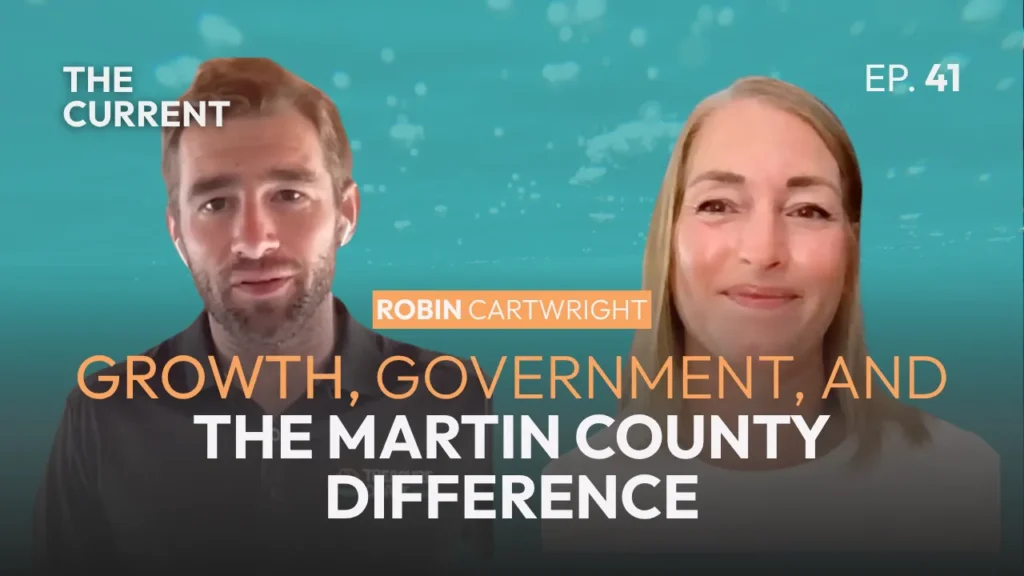
Robin Cartwright started the Save Martin County page, whose name stands for Stewards Advocating for a Viable Environment, after filing a lawsuit against the city of Stuart over what she described as an improper land use assignment. With limited ability to speak publicly during the litigation, she began documenting her case online. The effort has since grown into a broader resource for residents across Martin County trying to understand how development decisions happen.
Why Local Government Feels Confusing
One of the recurring themes in the conversation is how difficult it can be for residents to figure out which government body is responsible for a given decision. A single development project might involve a city commission, county staff, the South Florida Water Management District, and the Florida Department of Environmental Protection, each with authority over a different piece of the process.
Cartwright said the first step for any resident trying to understand a project is determining whether it falls under city or county jurisdiction, since that determines where to start researching. She noted that Martin County’s system for tracking permits and applications is not always easy to navigate, which can leave residents feeling like they are only getting part of the picture even when officials are being accurate about their specific area of responsibility.
She also described helping residents file public records requests, often on their behalf when they prefer not to have their names attached to the request.



The Live Local Act and Local Oversight
A significant portion of the conversation focused on Senate Bill 102, commonly known as the Live Local Act. Cartwright argued that the law has reduced local government’s ability to review certain housing projects that developers designate as affordable housing under the act.
According to Cartwright, developers who qualify under Live Local receive greater density than they would otherwise be permitted, but the law does not require them to report how many units are actually rented at income-qualified rates, and there is no formal application process for residents seeking to live in the units. She said this creates a gap between the stated purpose of the law and how it functions in practice, since local commissions cannot deny these projects once they meet the law’s criteria.
The conversation also touched on Senate Bill 180, which Cartwright connected to hurricane recovery provisions. She raised concerns about how its scope could extend well beyond the original storm event that triggered it, depending on how it is applied.
For more on how city leadership approaches growth and development decisions, TreasureCoast.com previously spoke with Stuart Mayor Chris Collins about similar issues facing the city.
How Annexation Changes What Gets Built
Cartwright described annexation, the process of a city absorbing land from unincorporated county territory, as a tool that developers can use strategically. When land moves from county to city jurisdiction, it can become eligible for greater density, smaller setback requirements, and taller building heights than the county would have allowed.
She said this process often surprises residents who only become aware of a project once construction is underway, without realizing the land had been annexed years earlier as part of a longer approval process.
TreasureCoast.com has also spoken with Stuart City Commissioner Sean Reed about how commission decisions on annexation and land use come together.
Wetlands, Retention Ponds, and Stormwater
Cartwright spent time distinguishing between wetlands and retention ponds, two things she said are often treated as interchangeable in development discussions but function very differently. Wetlands act as a natural filtration system for stormwater before it reaches the estuary. Retention ponds are engineered structures designed to manage runoff, but they do not replicate the same filtration process.
She raised concerns about construction runoff entering waterways before stormwater systems are complete, arguing that assurances that a project will be “fixed” once finished do not address the environmental impact that occurs during construction itself.
The relationship between development and estuary health has also come up in a previous conversation with the Florida Oceanographic Society about protecting local ecosystems.
What Sets Martin County Apart
Looking ahead, Cartwright said she hopes Martin County retains characteristics that distinguish it from surrounding counties, describing a trend toward similar development patterns up and down the Treasure Coast. She pointed to differences in building height and green space when crossing from Saint Lucie County into Martin County as an example of what residents currently notice, and expressed concern that continued growth could erode those differences over time.
She also discussed Indiantown specifically, referencing proposed data center development and its potential effects on water resources and neighboring agricultural land.
Encouraging Civic Participation
Throughout the conversation, Cartwright returned to the idea that residents benefit from getting involved in local decisions before they are finalized rather than after. She said many people do not engage with development issues until a project directly affects them, which she called understandable but limiting, since by the time a project reaches approval, the window for meaningful input has often closed.
She encouraged residents to:
- Determine whether a project falls under city or county jurisdiction before researching it
- Attend public meetings and candidate forums when possible
- Ask questions about density, traffic, and water use rather than accepting general assurances
- Vote in both primary and general elections
Cartwright closed the conversation by expressing appreciation for residents who attended a recent candidate forum in Martin County and asked questions about local development issues, describing their participation as a sign that more people are paying attention to how these decisions get made.
Voting and water policy on the Treasure Coast were also central to a previous TreasureCoast.com conversation on water issues ahead of local elections, a theme that runs alongside much of what Cartwright discussed here.